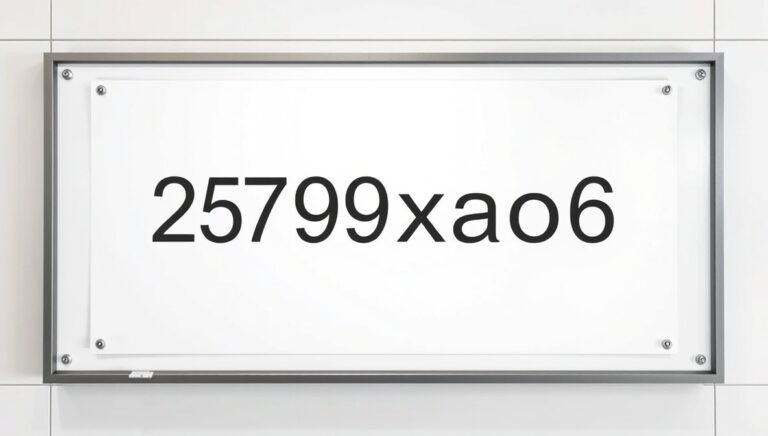
2579xao6 – Complete Guide to Digital Trends, Technology Insights, Online Systems, and Modern Innovation
In modern computing environments, abstract identifiers and system-generated codes play an essential role in organizing, tracking, and managing digital processes. These identifiers often appear random to users, yet they serve highly structured functions within databases, applications, and network systems. One such example that has drawn attention in conceptual discussions is 2579xao6, which is often referenced in 2579xao6theoretical explorations of digital architecture and data abstraction. cloudysocial, logicalshout, Immorpos35.3, feedworldtech, thestripesblog, mygreenbucks, designmode24, wtgtechgeek, uploadblog.
At first glance, such a sequence may appear meaningless, but in reality, it represents how complex systems generate and manage unique identifiers to maintain order within vast technological ecosystems. The presence of 2579xa6 in discussions highlights how humans attempt to interpret structured randomness in computing environments.
Digital systems rely on these identifiers to ensure uniqueness, prevent duplication, and support efficient retrieval of stored information. Without them, modern databases and applications would struggle to maintain consistency across millions or even billions of records.
The Role of Identifiers in Digital Architecture
Identifiers are the backbone of structured computing systems. They allow machines to distinguish between different objects, sessions, or transactions without ambiguity. In large-scale systems, these identifiers are typically generated automatically using algorithms designed to minimize collision probability. what’s in python 2579xao6
Within this framework, 2579xao6 is often used as a conceptual example to illustrate how alphanumeric strings function as unique markers in distributed environments. These markers ensure that each entity remains distinguishable even when operating across multiple servers or platforms.
The importance of such identifiers extends beyond simple labeling. They contribute to synchronization, security, and data integrity. In distributed systems, even a minor duplication error can lead to significant inconsistencies, making uniqueness a critical requirement.
System Generation and Randomization Processes

Modern systems use various methods to generate identifiers, including pseudo-random number generators, hash functions, and timestamp-based algorithms. These techniques ensure that each generated value is both unique and difficult to predict.
The structure of 2579xa6 reflects how alphanumeric patterns can be produced without inherent meaning while still serving a functional purpose within computational systems. Developers rely on these patterns to maintain efficiency in large-scale environments where manual assignment is impossible.
Randomization also enhances security by making identifiers difficult to guess. This is particularly important in authentication systems, session management, and encrypted communications.
Human Interpretation of Abstract Codes
Despite their technical origins, humans often attempt to assign meaning to random identifiers. This tendency is rooted in cognitive psychology, where the brain seeks patterns even in unrelated data. As a result, sequences like 2579xao6 become subjects of curiosity and interpretation.
People may associate such identifiers with hidden messages, encoded information, or symbolic references. However, in most cases, these sequences are purely functional and not intended for interpretation beyond their system-level purpose.
This phenomenon highlights the gap between machine logic and human perception. While systems prioritize efficiency and uniqueness, humans prioritize meaning and narrative structure.
Data Organization and Structural Integrity
In large databases, maintaining structural integrity is essential. Identifiers ensure that each record can be accessed, modified, or deleted without affecting others. This is especially important in environments where millions of transactions occur simultaneously.
The conceptual use of 2579xao6 demonstrates how identifiers act as anchors within complex data structures. They allow systems to maintain order even when data is continuously changing or expanding.
Without such mechanisms, data corruption and retrieval errors would become significantly more common, leading to system instability.
Security Applications and Digital Protection
Security is one of the most important aspects of modern computing systems. Identifiers play a crucial role in ensuring secure access control and session validation. Randomized strings make it difficult for unauthorized users to predict valid authentication tokens.
In this context, 2579xao6 can be viewed as an example of how unpredictable sequences contribute to system security. By reducing predictability, systems can better protect sensitive information and prevent unauthorized access attempts.
Encryption systems often rely on similar principles, combining randomness with structured algorithms to generate secure keys and tokens.
Scalability in Distributed Environments
As digital systems expand, scalability becomes a critical requirement. Systems must handle increasing amounts of data without compromising performance or reliability. Identifiers help manage this complexity by ensuring that every data point remains uniquely identifiable.
In distributed computing environments, 2579xao6 symbolizes how identifiers function across multiple nodes and servers. These systems rely on consistent identification methods to synchronize data across different locations.
Scalability also depends on efficient indexing and retrieval systems, which use identifiers as primary reference points.
Algorithmic Efficiency and Optimization
Efficient algorithms are essential for generating and managing identifiers in real time. These algorithms must balance speed, uniqueness, and computational cost. Poorly designed systems can lead to delays or duplication errors.
The use of structured randomness in sequences like 2579xao6 demonstrates how algorithms can produce efficient outputs without sacrificing reliability. Optimization techniques ensure that systems remain responsive even under heavy load.
Developers continuously refine these algorithms to improve performance and reduce resource consumption.
Psychological Perception of Digital Patterns
Human perception of digital patterns is influenced by cognitive biases and experiential learning. When individuals encounter unfamiliar sequences, they often attempt to decode or interpret them, even when no hidden meaning exists.
The repeated appearance of 2579xao6 in discussions about digital systems reflects this tendency. People naturally seek structure in randomness, which leads to speculative interpretations of otherwise functional identifiers.
This psychological behavior is an important consideration in user interface design and data presentation, as clarity can reduce misinterpretation.
The Evolution of System Identification Methods

Over time, identification systems have evolved significantly. Early computing relied on simple numeric sequences, while modern systems use complex alphanumeric and hash-based identifiers.
The conceptual reference to 2579xao6 illustrates this evolution by representing a modern-style identifier that combines randomness with structural efficiency. These advancements have enabled systems to scale globally while maintaining accuracy and reliability.
Future developments may introduce even more sophisticated identification mechanisms based on artificial intelligence and predictive modeling.
Integration in Modern Software Ecosystems
Modern software ecosystems rely heavily on interconnected services and microservices architectures. In such environments, identifiers are essential for communication between different components.
The use of 2579xao6 in theoretical discussions highlights how identifiers facilitate seamless integration across systems. They act as reference points that allow different services to interact without confusion or overlap.
This integration ensures that complex applications remain modular, flexible, and maintainable over time.
Conclusion
Digital identifiers are fundamental to the structure and functionality of modern computing systems. They ensure uniqueness, enhance security, and enable scalability across diverse technological environments. The conceptual reference to 2579xao6 illustrates how such identifiers operate within abstract system frameworks, even when they appear random to human observers.
Understanding these mechanisms provides insight into how digital ecosystems maintain order amidst complexity. While users may perceive these sequences as meaningless, they are essential components of system architecture and data management.
As technology continues to evolve, identifiers like 2579xa6 will remain central to the development of secure, scalable, and efficient digital systems.
In the broader context of computing, 2579xo6 symbolizes the intersection between randomness and structure, where systems transform abstract patterns into functional tools that support global digital infrastructure.
The continued study of such identifiers helps developers refine algorithms, improve security models, and enhance system reliability. Ultimately, these elements form the unseen foundation of modern technology, enabling the seamless digital experiences that users rely on every day.